
Introduction
As artificial intelligence (AI) continues to evolve, one major challenge remains: helping language models access and act on real-world data.
While models like GPT and Claude are excellent at generating language, they often lack context about your business systems, databases, or tools. Model Context Protocol (MCP) solves this problem by giving AI a standard way to connect to external data and services — safely and efficiently.
What Is the Model Context Protocol (MCP)?
The Model Context Protocol (MCP) is an open, standardized communication layer that allows AI models to interact with external systems such as APIs, databases, and tools.
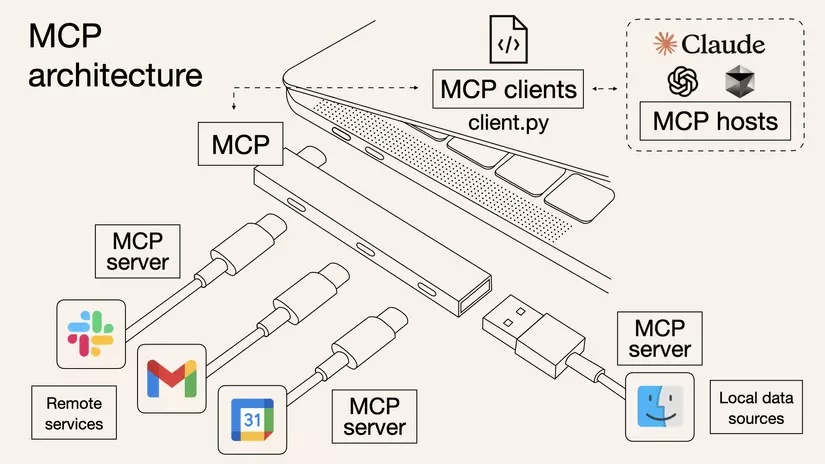
Think of MCP as the “USB-C for AI” — a universal connector that lets different systems work together seamlessly, without the need for custom integrations.

Why MCP Matters for the Future of AI
Before MCP, developers had to manually integrate each AI model with every service it needed to access. This was slow, inconsistent, and difficult to maintain.
MCP changes that by introducing a shared protocol, enabling models to:
- Access enterprise data from internal systems and knowledge bases.
- Use external tools like Slack, Google Drive, Jira, or SQL databases.
- Understand user context and make data-driven decisions in real time.
How MCP Works
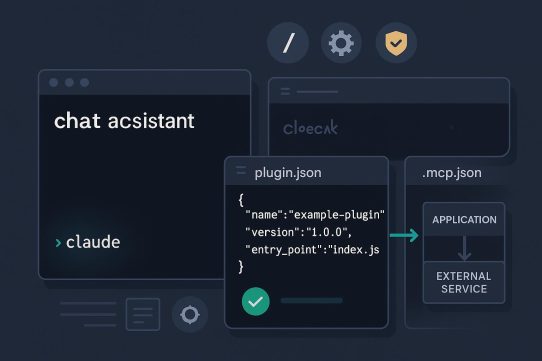
MCP operates through two main components:
- MCP Server — provides access to tools, APIs, or databases (e.g., a Salesforce or Notion integration).
- MCP Client — typically the AI model or chatbot that sends structured requests via MCP.
When an AI client requests data or triggers an action, the MCP server processes it and returns results — enabling the model to act on live business information.
Core Benefits
- Standardized Integration – One universal format for all external tools.
- Faster Development – Reduce the need for one-off custom connectors.
- Enterprise Security – Granular permissions and controlled data access.
- Scalable Architecture – Add or replace tools easily with minimal effort.
Challenges Ahead
Despite its promise, MCP is still evolving. Key challenges include:
- Securing sensitive data in enterprise environments.
- Managing multiple MCP servers efficiently.
- Defining authentication and access control standards.
- Maintaining speed and reliability across complex systems.
However, the open-source community and major AI companies are actively contributing to MCP’s growth — paving the way for widespread adoption.
Real-World Use Cases
- Enterprises: Integrate ChatGPT Enterprise with internal CRMs, analytics tools, or knowledge bases.
- Developers: Build AI apps that interact directly with APIs through MCP.
- Researchers: Automate data analysis and retrieval using standardized AI interactions.
Conclusion
The Model Context Protocol (MCP) represents a major step toward making AI truly context-aware and actionable.
Instead of operating as isolated “black box” models, AI systems can now connect, reason, and act across a company’s digital ecosystem.
MCP isn’t just a technical framework — it’s a bridge between intelligence and execution, allowing AI to work with the same tools and data humans use every day.
🌟 In essence, MCP turns AI from a passive assistant into an active partner that understands, collaborates, and delivers real-world value.